We've detected you are outside the United States. Switch to our International site by clicking below
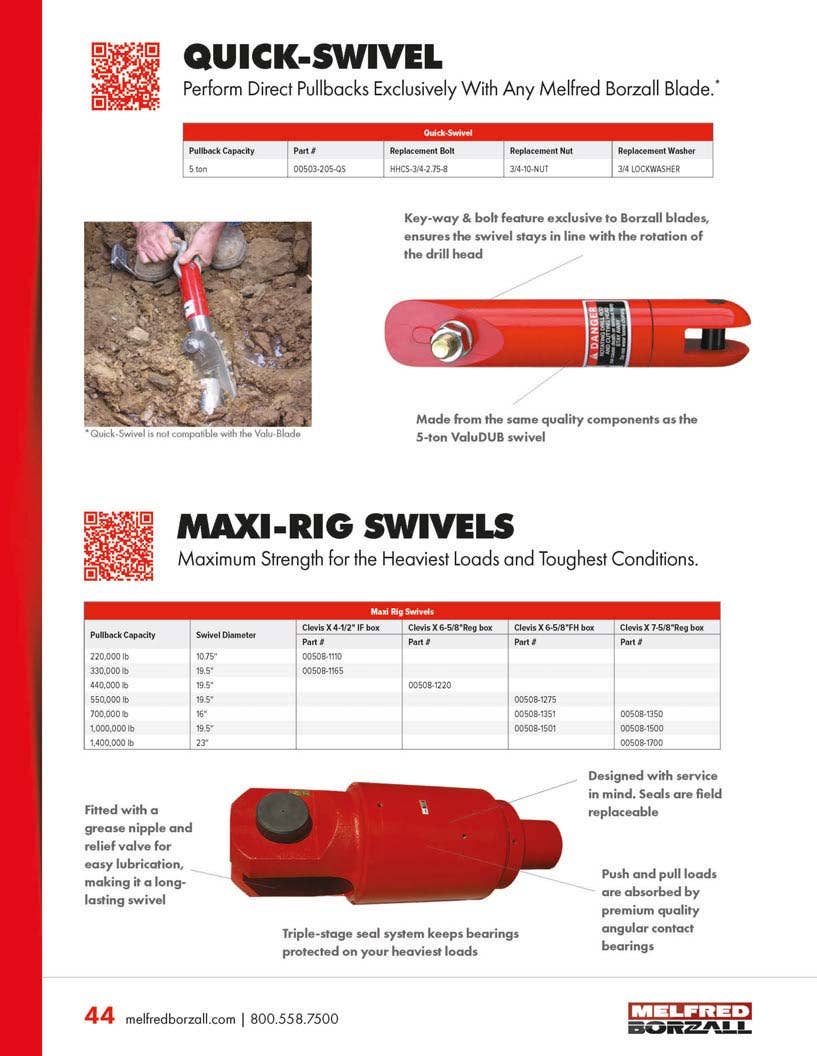
Don't worry about taking the blade off for direct pullback with this swivel. This quick swivel directly attaches to your Melfred Borzall blade for easy pullback.
| Rig Model: D6x6, D7x11A, D7x11A S2, D8x12, D9x13, D9x13 S2, D9x13 S3, D10x15, D10x15 S3, D16x20, D16x20 S2, D18x22, D20x22 S2, D20x22 S3, D23x30 S3, D24x26, D24x33, D24x40, D24x40A, D24x40 S2, D24x40 S3, JT5, JT9, JT10, JT20, JT25, JT30, JT520, JT920, JT920L, JT921, JT922, JT1220 M1, JT1720, JT1720 M1, JT2720, JT2020, JT2720 M1, JT2720 AT, JT3020, DD65, DD1215, DD1416, DD2024, DD2226, 4X |
| Housing Type: Bolt-on, Side-load |
| Pullback Type: Quick-Swivel |
| Swivel Type: Quick Swivel |
| Swivel Capacity: 5 ton (10,000 lbs) |
Short Answer: The "M" Indicates a male connection. This is also sometimes referred to as a "pin" connection.
Correct use: "M" connection tooling, or male connections shoud always mate up to a female (F) connection.
Technical details: When configuring tooling connections, be mindful of the gender of the tooling you are connecting to. Connection size and gender are main factors when configuring tooling connections. Avoid excessive adapter use to limit failure points in your drill string.
Short Answer: A QuickSwivel is used during pullback with directional blades to prevent the product from rotating as it is installed.
Correct use: A QuickSwivel is installed between the directional blade and the product being pulled to isolate rotational forces. This helps protect the product from twisting or damage during installation.
Technical details: The swivel allows free rotation between the drill string and the product while maintaining tensile load. This is especially important when pulling pipe, conduit, or bundled product that should not rotate during installation. The QuickSwivel has a bolt-on connection that bolts to the blade without having to disconnect the blade from the steerface.
Incorrect use includes: Pulling product without a swivel when rotation is present or using a swivel that is undersized for the pullback load. Incorrect use can introduce greater risk of product damage, joint failure, or installation issues.
Short Answer: A Quick Swivel is compatible with directional blades for connection to the rig side, and have a load capacity of 5 tons (10,000 lbs) for pulling product.
Short Answer: A Quick Swivel can be used in any ground condition the directional blade being used can handle when pulling product.
Correct use: A Quick Swivel is used based on pullback requirements rather than soil type. It can be run in dirt, clay, mixed ground, or rock whenever rotation needs to be isolated from the product being installed.
Technical details: Ground conditions affect cutting tools and reamers, but swivel performance is determined by load, alignment, and connection integrity. As long as the swivel is properly sized for the pullback forces, ground type does not limit its use.
Incorrect use includes: Selecting a swivel based solely on ground conditions instead of pullback load or failing to account for tensile forces during installation. Incorrect use can introduce greater risk of swivel overload or product damage.
Short Answer: Eye swivels and duct pullers serve different purposes during pullback and are not interchangeable.
Correct use: An eye swivel is used when pulling product that already has an external pulling eye or adapter and needs to rotate independently of the drill string. A duct puller is used when the product must be gripped internally, such as conduit or duct without an external pulling attachment.
Technical details: Eye swivels manage rotation and help prevent product twist, while duct pullers create an internal mechanical grip inside the product itself. The correct choice depends on whether the product has an external pull point or requires internal engagement.
Incorrect use includes: Using an eye swivel when no external pull point exists or attempting to pull duct without proper internal grip. Incorrect use can introduce greater risk of slippage, product damage, or installation failure.